
Persimmon Seed Forecast 2026: Spoon, Knife, or Fork?

Quick Reference: Reading a Persimmon Seed
- What you need: a ripe, locally grown persimmon, not a supermarket Fuyu
- When: after the first frost, when the fruit goes soft
- Spoon shape: folklore says heavy, wet snow
- Knife shape: folklore says cutting, icy winds
- Fork shape: folklore says light, powdery snow
- Inside the seed: the white shape is the cotyledon, the seedling’s first leaf
Every autumn, somebody splits a persimmon seed, holds up the white shape inside and announces the winter. It is one of the oldest weather traditions in the country, and it is genuinely worth doing. It is also worth understanding what you are actually looking at.
How to Cut One Properly
The tradition only works with a persimmon grown where you live, because the whole idea is that the fruit read your local season. An American persimmon (Diospyros virginiana) is the traditional choice. Supermarket Fuyu and Hachiya persimmons are usually grown a long way from your winter.
- Wait until after your first frost. Before that the fruit is astringent and the seeds are not fully formed.
- Choose a soft, fully ripe fruit. A firm persimmon will pucker your mouth and tell you nothing.
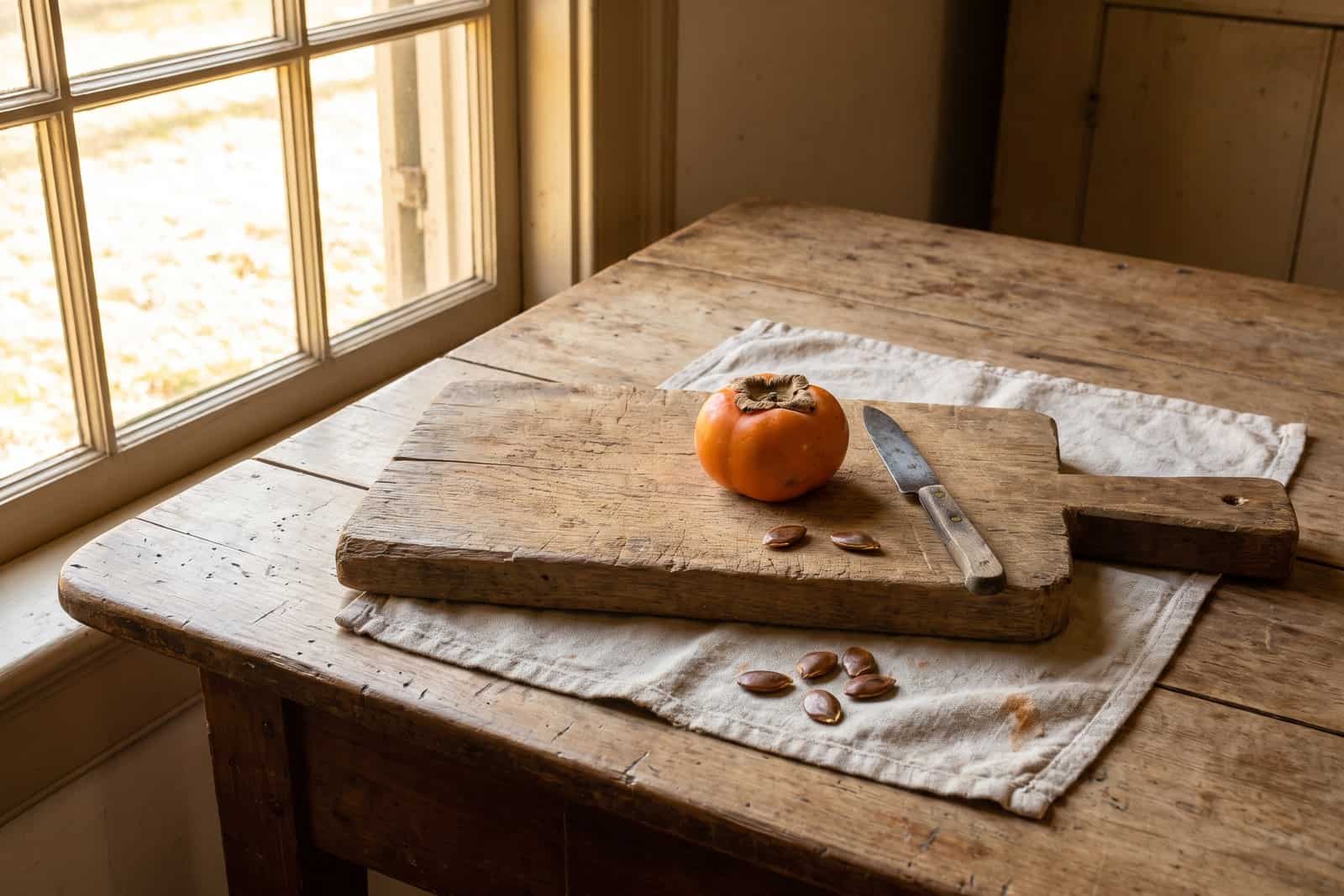
- Cut the fruit open and find the seeds. Most hold four to eight.
- Lay a seed flat and cut it lengthwise with a sharp knife. Cut slowly, they are hard and they skid.
- Look at the pale shape inside. That is the cotyledon, the seed leaf.
Where the Tradition Comes From
The persimmon is a native tree, and so is the custom. The name itself is borrowed: the Powhatan called the fruit pichamins. The seed reading is strongest in Appalachia, the Ozarks and the rural South, which is exactly the range of the American persimmon, and it turns up in nineteenth century farm almanacs and southern newspapers long after it was already common practice.
That geography matters more than it sounds. The tradition belongs to one species, Diospyros virginiana, which grows wild across USDA zones 4 to 9 in the eastern United States. It is sometimes called the first frost fruit, because it needs a long season and usually is not worth eating until the cold has been at it.
| American persimmon | Asian persimmon | |
|---|---|---|
| Species | Diospyros virginiana | Diospyros kaki |
| Size | Small, roughly golf ball | Large, roughly tomato |
| Where from | Wild across the eastern US | Orchards, often imported |
| Seeds | Several, large and flat | Few or none in Fuyu |
| Ripe when | Soft and wrinkled, after frost | Firm (Fuyu) or jelly soft (Hachiya) |
| Tradition applies | Yes | No |
What the Three Shapes Mean
| Shape inside the seed | What the tradition says | What people picture |
|---|---|---|
| Spoon | Heavy, wet snow, the kind you shovel | A scoop, as in shovelling out the driveway |
| Knife | Cold that cuts, icy winds | A blade, as in a wind that slices through a coat |
| Fork | A mild winter with light, powdery snow | Tines, as in snow you can sweep off the step |
Cut several seeds from several fruit. Growers who do this every year will tell you the shapes are rarely unanimous, and that is part of the fun of it.
What the Shape Inside the Seed Is
The shape inside the seed is the cotyledon, the first leaf the seedling would put out if it germinated. It formed when the flower was fertilised in late spring and finished growing while the fruit ripened through the summer.
A persimmon seed is a lovely piece of folk record keeping and a good excuse to get outside with a paring knife. If you want the long range outlook alongside it, see the Farmers’ Almanac 2026-2027 winter forecast, which is built from our own long range formula.

When to Look Where You Live
Persimmons ripen after frost, so your cutting date moves with your frost date. These are the published Farmers’ Almanac first frost normals, which is the earliest the fruit is usually worth picking.
| Region | Example city | Average first frost | Cut your seeds |
|---|---|---|---|
| Upper Midwest | Duluth, MN | September 27 | Early October |
| Northern Plains | Fargo, ND | October 1 | Early October |
| Mountain West | Denver, CO | October 7 | Mid October |
| Great Lakes | Detroit, MI | October 20 | Late October |
| Midwest | Chicago, IL | October 28 | Late October |
| Mid South | Nashville, TN | October 31 | Early November |
| Mid-Atlantic | Philadelphia, PA | November 6 | Early November |
| Southeast | Atlanta, GA | November 19 | Late November |
| South Central | Dallas, TX | November 17 | Late November |
Check your own city on the 2026 first frost map. If the fruit still puckers your mouth, it is not ready and neither are the seeds.
Frequently Asked Questions
When should I cut a persimmon seed for the 2026-2027 winter?
After your first frost, once the fruit has gone soft. For most of the country that falls between early October and early November. Cutting early gives you an underdeveloped seed and a sore mouth.
What does each persimmon seed shape mean?
A spoon shape is read as heavy, wet snow, the kind you shovel. A knife is read as cutting, icy winds. A fork is read as light, powdery snow. Cut several seeds from several fruit and take the majority shape.
Can I use a supermarket persimmon?
You can cut one open, but the tradition depends on fruit grown in your own climate. Most supermarket persimmons are Fuyu or Hachiya varieties grown far from where you will spend the winter.
What if the seeds disagree with each other?
That is normal and it happens most years. Cut several seeds from several fruit and take the majority shape, which is how the tradition has always been used.
What is the shape inside the seed?
It is the cotyledon, the seed leaf that would feed the seedling if it germinated. Every persimmon seed has one, and they naturally vary in shape.
Read Next
- Persimmon Seed Weather Prediction: The Full Tradition
- 2026 First Frost Map: When Frost Arrives Where You Live
- 20 Signs of a Hard Winter Ahead

Josh Morley grew up in Liverpool, where checking the sky before you leave the house is less a habit than a survival skill. He has spent his working life with data, and he came to the Farmers' Almanac by way of the thing the two have in common: the weather is the largest dataset any of us live inside, and most of us read it every day without noticing.
- Josh Morley

- Josh Morley
- Josh Morley
- Josh Morley